Archimedes' Principle
Introduction
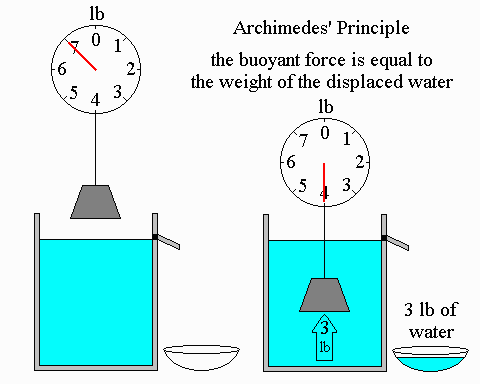
Archimedes' principle indicates that the upward buoyant force that is exerted on a body immersed in a fluid, whether fully or partially submerged equals to the weight of the fluid that the body displaces. Archimedes' principle is a law of physics fundamental to fluid mechanics. Archimedes of Syracuse formulated this principle, which was named after him.

Basically,Archimedes’ principle allow us
to measure the volume of an object. This can be done by measuring the volume of
liquid that was displaced once the object has submerged and to buoyancy of the
object be calculated.Volume of the submerged portion
is equivalent to the volume of liquid it displaces no what the object as long
as it is immersed.In determining whether a given body will float in a given fluid, both weight and volume must be considered; that is, the relative density, or weight per unit of volume, of the body compared to the fluid determines the buoyant force. If the body is less dense than the fluid, it will float or, in the case of a balloon, it will rise. If the body is denser than the fluid, it will sink. Relative density also determines the proportion of a floating body that will be submerged in a fluid. If the body is two thirds as dense as the fluid, then two thirds of its volume will be submerged, displacing in the process a volume of fluid whose weight is equal to the entire weight of the body. In the case of a submerged body, the apparent weight of the body is equal to its weight in air less the weight of an equal volume of fluid. The fluid most often encountered in applications of Archimedes' principle is water, and the specific gravity of a substance is a convenient measure of its relative density compared to water. In calculating the buoyant force on a body, however, one must also take into account the shape and position of the body. A steel rowboat placed on end into the water will sink because the density of steel is much greater than that of water. However, in its normal, keel-down position, the effective volume of the boat includes all the air inside it, so that its average density is then less than that of water, and as a result it will float.

Read more: Archimedes' principle | Infoplease.com http://www.infoplease.com/encyclopedia/science/archimedes-principle.html#ixzz3Aw0pwVcq
Formula of Archimedes Principle
Archimedes' principle describes the relationship between the buoyant force and the volume of the displaced fluid, but also the density of the displaced fluid.
We can write this principle in equation form as:
FB = ?f Vf g
where FB is the buoyant force, ?f is the density of the displaced fluid, Vf is the volume of the displaced fluid, and g is the acceleration due to gravity, 9.8 m/s2. It's very important to remember that the density and volume in this equation refer to the displaced fluid, NOT the object submerged in it.
This equation is helpful because you can use it to determine the buoyant force on an object. For example, say you submerge an object in water and find that the object displaces 1.0 liter of water. Water has a density of 1.0 kg/L, so now we have everything we need to determine the buoyant force acting on the submerged object because we have the volume and density of the displaced fluid. Consequently, we also have the volume of the object because this is the same volume as that of the displaced fluid!
To calculate the buoyant force, simply plug in the numbers. Now our equation reads: FB = 1.0 kg/L * 1.0 L * 9.8 m/s2. Once we do the math, we find that the buoyant force equals 9.8 kg-m/s2, which is the same as 9.8 Newtons.
If the weight of the object is more than 9.8 N, then the object will sink. If it is less than 9.8 N, the object will float. But if the weight of the object is exactly 9.8 N, then the object will neither sink nor float because it is the same as the buoyant force.
Read more: Archimedes' principle | Infoplease.com http://www.infoplease.com/encyclopedia/science/archimedes-principle.html#ixzz3Aw0pwVcq
